Stardust
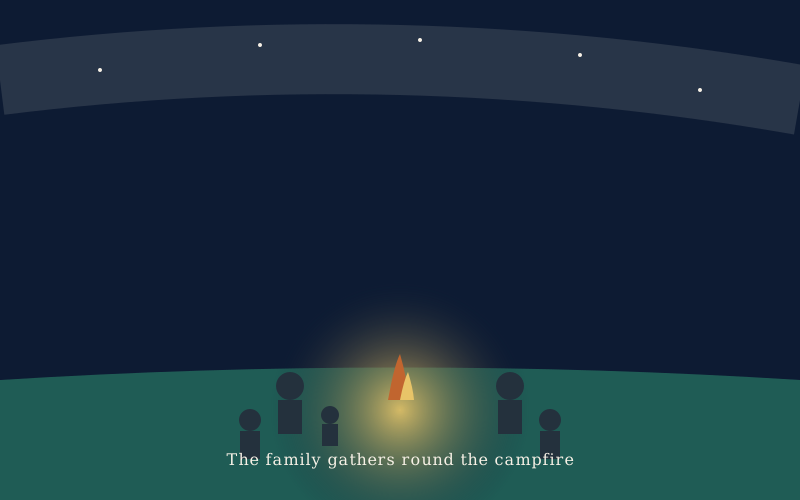
It was the winter season. To escape the severe pollution of the city, Marisha, along with Mamma, Baba, Thammi, Dada and Susho, went to a resort in a hill station for the weekend. The resort was surrounded by green hills, beyond which stretched the mountain ranges. Though it was quite cold, the fresh crisp air of the hills energized Marisha. She played in the lawns and gardens below. At night, the family, well protected with warm clothes, huddled round a blazing campfire lit by the resort staff on the lawn. Overhead, the sky was filled with thousands of stars, and the Milky Way stretched like a river from one end of the sky to the other. It was a beautiful sight. The vastness of the cosmos filled everyone with awe and wonder. The people living in the city can never enjoy this beauty, because of the city lights and the thick cover of dust which make the stars invisible.
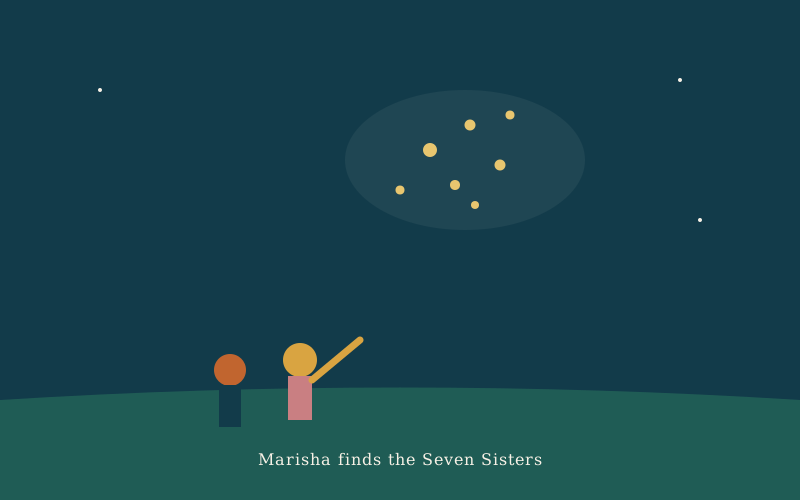
Marisha looked up at the stars and suddenly found a patch containing a large number of stars clustered together in one small corner of the sky near the horizon. She counted up to ten stars, including seven bright ones. She was a curious girl who had heard of constellations, and asked, "Dada, is that a constellation?" Dada said, "Yes, Marisha, it is the constellation of Pleiades, a star cluster consisting of a thousand very young stars." "Dada, how many stars can you see in Pleiades?" Dada peered into the sky and could count only up to three. Marisha laughed, "Dada, I have beaten you — I have better eyesight than yours!" Dada chuckled, "How can this old man be better than my dear granddaughter at anything? I always lose. Do you know, people used to check how good their eyesight was by counting the stars in Pleiades, just as you did. Good job, Marisha."
"Dada, do you know the story about this constellation?" "Yes, I do," said Dada. "There is an ancient Greek myth. The Pleiades were seven nymphs — daughters of the Titan Atlas and the sea-nymph Pleione — who were transformed into doves, and then into stars, by Zeus, the king of the Gods, to protect them from the hunter Orion. Known as the 'Seven Sisters,' they were companions to the goddess Artemis. The seven sisters are named Maia, Electra, Taygete, Alcyone, Celaeno, Sterope, and Merope. The brightest star is Alcyone." Marisha was excited. "I am also a nymph, Dada — not of the sea, but of the forest — the baby of the trees, and daughter of the wind and the moon." Thammi said, "Yes, you are my beautiful nymph, Marisha," and hugged her, and Marisha squealed in delight. Dada continued, "In Indian mythology, the constellation is called Krittika, and the seven stars represent the seven wives of the seven rishis of the constellation Saptarshi. The names of the wives are Amba, Dula, Vitani, Abhrayanti, Meghayanti, Varshayanti, and Chupunika."
Scanning the skies, Marisha, as curious as ever, asked, "But Dada, when there are so many millions of stars in the sky, then the sky at night should shine brightly with the light of so many stars — it should be much brighter than daylight. So why is the sky so dark at night?" "That is a very clever question, Marisha. Let me explain. You are seeing millions of stars tonight because the light from every one of those stars has reached your eye. If light from a star or galaxy far away does not reach you, you will not see it, even though it is still there in the space beyond. The space we see is infinite, which means it stretches to very large distances with no end. But why is there no end to space? It is because our universe, which started as a small, very hot point at the Big Bang a very long time ago, is expanding very fast. Just imagine the universe is like a balloon with dots drawn on it. If you blow up the balloon, it expands and becomes bigger and bigger, and all the dots move away from each other. The stars and galaxies, like dots on the balloon, were closer together long ago when the Big Bang occurred. But now they are far apart, with the furthest ones moving fastest and flying further apart as the universe expands. Though there are trillions of stars and galaxies spread throughout the sky, many are so far away, because of this stretching of the universe, that light from them still has not reached us on Earth. This is why you see huge black gaps in the sky between the stars and galaxies. The sky is dark, thanks to the Big Bang."
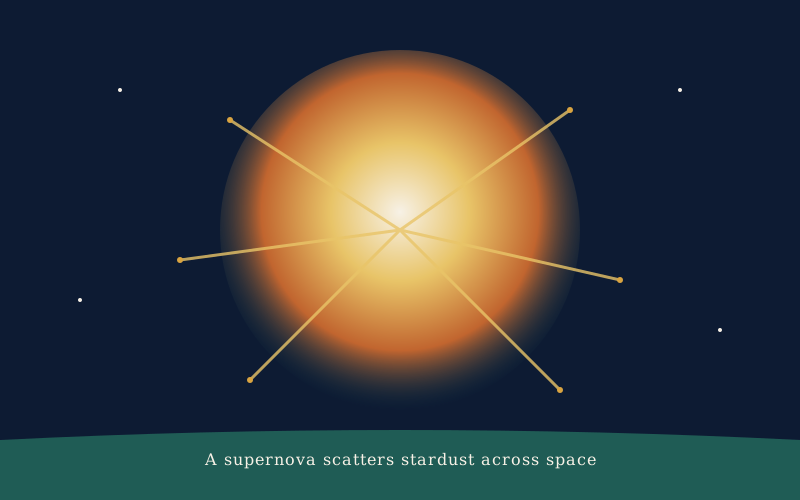
"But Marisha, I will tell you another story, which is equally fascinating. Can you tell me what we are made of?" Marisha immediately shouted, "I know, Dada! We are made of atoms. I read it in the book 'The Littlest Girl Goes Inside the Atom.' They are so small that a single full stop like this one has a sextillion atoms — that's a one followed by twenty-four zeroes." "Oh my dear, I did not know this," said Dada. "The question is, what is inside the atom?" Marisha was quick to reply: "Protons, neutrons and electrons." "Correct. Now, these tiny atoms form the elements — like hydrogen, oxygen, carbon, nitrogen, calcium, iron and others — which make up our bodies. The oxygen which we breathe, the carbon which gives us energy and makes proteins, the iron which is in our blood, and the calcium which is in our bones, were all made when big stars died. But how?" Marisha asked. "You see, these elements were thrown into space when those stars exploded in a massive explosion called a supernova. After drifting through space for millions of years, these elements came to Earth, and ultimately entered our bodies when we were born. So Marisha, we are made of stardust." Everyone was astounded to hear this. "Is it really true, Dada?" exclaimed Marisha. "Yes, it is true, my dearest." "So we are children of the stars," she said thoughtfully.
The campfire was getting low and dim, and a cold wind from the mountains made everyone shiver. It was getting late, and Marisha was feeling very tired, having spent the entire day playing on the lawn. As she grew drowsy, Baba carried her in his arms and walked back to the resort. Susho changed her clothes, and she was tucked up in bed under the warm quilts, with Mamma lying beside her, cuddling her. In no time she fell asleep, dreaming of the stars and the angels who floated in the heavens above, singing lullabies to put the children to sleep.