Galactic Year
From Dinosaurs to Birds to Humans: the story of the Sun in a Galactic Year.
Beanie and Dada were having a nice walk in the playground of Fresco. It was a crisp winter morning and a mellow sun shone in the sky. Children were playing, and the splashing sounds of water and shouts of kids in the enclosure meant that the swimming pool was open. A Tithari (Red-wattled Lapwing) was strutting around and picking up insects from the ground.
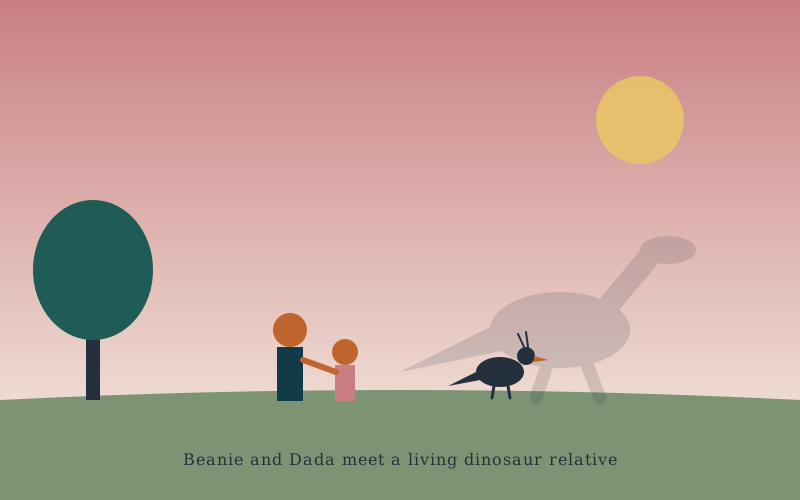
Dada said, "Beanie, when you come to Kolkata, where do you want to go and enjoy yourself?" Prompt came the reply: "I would like to go to Science City and see the dinosaur show. It's a lot of fun, though I feel scared inside the tunnel when the huge dinosaurs roar in the forests. Luckily, Dada, there are no dinosaurs now. We would not be alive if the dinosaurs were around. They would have gobbled us up. It is good that the asteroid hit the Earth and killed all the dinosaurs." Dada said, "Beanie, you are right in one way. But are you sure that we do not have a relative of the dinosaur now?" "Yes, I am sure," said Beanie. "You do not see a T-Rex or Brontosaurus or Triceratops anywhere on Earth." "You are right. But what if I said their relatives are still here?" Beanie rolled her eyes and said, "Dada, don't frighten me. Let's go back home." Dada laughed. "There is nothing to be afraid of, my dear. In fact, you are seeing a dinosaur right now, just in front of you." Beanie cried, "Dada, where is it? I can't see!" Dada hugged Beanie and pointed to the Tithari walking on the ground. "That Tithari, or for that matter all the ten thousand varieties of birds, are very close relatives of the dinosaur."
Beanie refused to believe. "Dada, you must be joking! How can such a small thing like a bird come from the huge, powerful dinosaurs?" Dada continued, "Yes, they do. Birds are not just descendants of dinosaurs. You are actually seeing a living, flying dinosaur." Beanie gasped in amazement. Dada said, "Birds come directly from a dinosaur group from an earlier time. They belong to the theropod family of two-legged, meat-eating dinosaurs." "But what is a theropod group?" Beanie asked. "The Tyrannosaurus rex and Velociraptor belong to this same family group. That is why I said the Tithari is a close relative of the T-Rex. The change from large reptiles living on the ground to small, flying birds happened over tens of millions of years, through a slow process of evolution."
"This is unbelievable!" cried Beanie. Dada said, "I will explain. From the fossils of dinosaurs, palaeontologists (scientists who study very old dead animals or plants in fossils) discovered the Deinonychus, a small dinosaur that lived about 115 million years ago. This dinosaur was a predator which killed and ate other animals. But it was special, as it had feathers. The gradual change from fast-running, ground-dwelling, two-legged theropods to small, winged, flying birds probably started about 160 million years ago. During this time the body size of the theropods became smaller and smaller, and they developed a toothless beak. It is possible that some small theropods moved into trees in search of food, or to protect themselves. Since they could fly, they were saved when the asteroid hit the Earth and killed all the big, slow dinosaurs on land. That is why you see their relatives, the birds, today." Beanie suddenly ran towards the Tithari, which was busy poking the ground with its sharp beak to pluck out insects. Taken by surprise, it screeched "Titire, titiree!" and flew away. "Look, Dada, I have frightened a dinosaur!" Dada hugged Beanie. "My naughty angel!" And they laughed heartily.
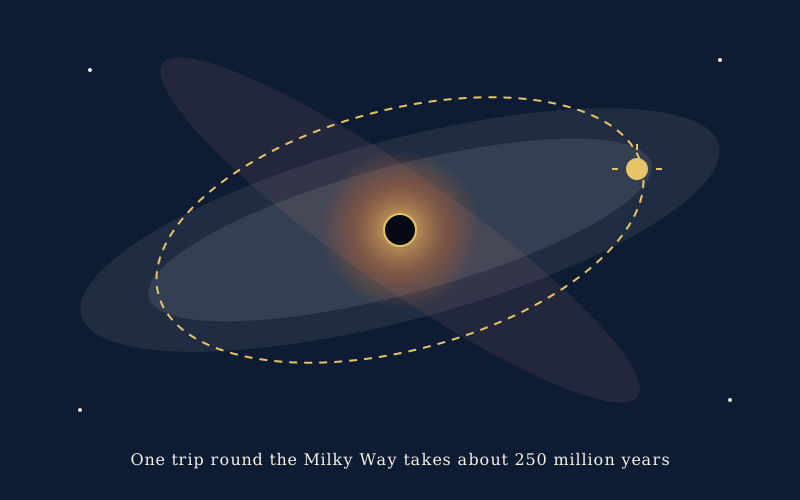
Beanie was still curious and asked, "We know that the dinosaurs lived on Earth from the fossils discovered in many parts of the world. But since there were no humans at that time, no one had seen a real, living, big one. Someone would have to be very old to see them." "But Beanie, there is someone who has actually seen them." "Who?" said Beanie excitedly. "Look up at the sky. What do you see?" "The Sun!" exclaimed Beanie. "Yes. The Sun was there when the dinosaurs roamed the Earth. Can you imagine how old the Sun is? It is 4.5 billion years old (4,500,000,000). It saw the dinosaurs when they first appeared on Earth about 230 million years ago, and also how they died when the asteroid crashed into the Earth 66 million years ago. All throughout this time, the Sun, along with its family of Earth and the other planets, was circling around the black hole at the centre of the Milky Way. You know our Earth also circles around the Sun. Do you know how much time our Earth takes to complete one circle around the Sun?" "It's easy, Dada! The Earth takes one year, which means 365 days. That is why my birthday happens every year, exactly on the 7th of June." "But Beanie, the Sun takes a lot more time, about 250 million years, to go round the centre of the Milky Way. The time to complete a full circle is called the Galactic Year." Beanie said, "Dada, why does it take such a long time? Does the Sun circle very slowly?" "No, the Sun moves very fast. But it takes so much time because it is far, far away from the black hole at the centre of the Milky Way. So you can understand how big empty space is. Ever since the Sun was born, it has completed twenty circles, or what we call orbits, so far."
"During its last orbit, the Sun has seen the Great Dying, when huge volcanoes wiped out ninety percent of the species on Earth. It has seen the first birds appear about 160 million years ago, and the first flowers spreading on the land around 120 million years ago. It has seen India break away from the supercontinent Pangaea and crash into the Eurasian continent about 50 million years ago." Beanie interrupted. "I know that! The mighty Himalayas were created because of this collision." "You are right, Beanie. But there is more to it. The Earth became very hot when the asteroid hit. But the mighty Himalayas absorbed the warm greenhouse gases (carbon dioxide and other gases) trapped in the atmosphere, and the Earth cooled. It became so cold that about 2 million years ago an ice sheet covered all of Russia, Canada, the USA as well as Europe. This was the start of the Ice Age. Around 26,000 to 19,000 years ago, the ice sheets were at their largest. Pittsburgh, where Rhea and Rhayansh stay, was covered in thick ice, and it remained like this for thousands of years."
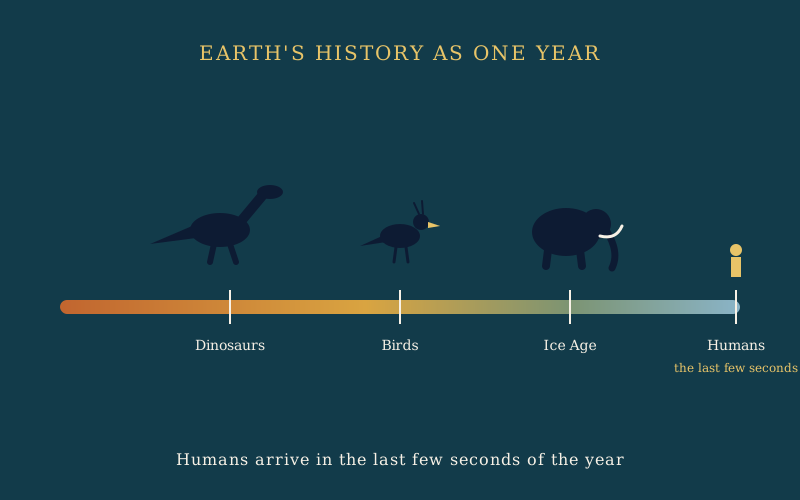
"The Sun also saw the first apes, who are our ancestors, appear 25 million years ago. Ultimately we, the first humans, appeared only 300,000 years ago. We were very brave and strong, and we survived the Ice Age. Not only did we have to withstand the extreme cold, we also had to fight and hunt the giant woolly mammoths, sabre-toothed cats, woolly rhinoceroses and massive short-faced bears for survival. Beanie, you remember seeing these animals in the Dark Ride tunnel. Around 11,700 years ago, global temperatures rose and the major ice sheets melted. If Earth's history was one year, each month would be 378 million years, and humans would appear only in the last few seconds. We are just like little newborn babies arriving on Earth."
Beanie exclaimed, "Dada, you are only 72 years old. How can you call yourself an old man when the Sun is so old? Its age is 4 billion years!" Dada said, "No, Beanie. The life of a star is different from that of a human. We live short lives, but the stars live much, much longer. The Sun is only a middle-aged star, having crossed only half of its life. It will circle another 22 to 25 orbits before it becomes enormous in size and turns into a red supergiant. Then it will die and collapse into a small but very heavy white dwarf star. It will take billions of years for the Sun to die, having used up its fuel of hydrogen. By this time, humans will go into space, discover new exoplanets and build space colonies where they will live and continue to flourish. This is why humans are planning to go to Mars and stay there, before taking the great leap forward to the exoplanets. NASA, SpaceX and Blue Origin are developing powerful rockets to go to Mars. In this way, by exploring and going further out into space, our human race will survive."
THE END